


Tagubu & Klimperei – Dis qu’t’as tort
Denis Tagu has spent much of his life moving between two poles: the shared language of the group and the quieter, more stubborn voice that insists on going its own way. He came into music sideways, a bass player stepping in as a keyboardist, borrowing instruments, learning by doing, absorbing as much from circumstance as from intention.
His first significant foothold came with Hellebore, a late 1970s French group whose brief existence left behind a single, restless album, ‘Il y a des jours‘. Drawing on avant-prog, Rock in Opposition, zeuhl, free jazz and musique concrète, they worked without a fixed center, closer in spirit to Henry Cow or This Heat than to anything resembling a stable genre. It was music made by young players testing limits rather than defining them, and it shows.
What followed was not a clean progression but a kind of persistence. Through Toupidek Limonade, through the tape-trading patience of Szentendre, Tagu kept working, shifting between collective construction and more personal lines of thought. There is no single aesthetic he returns to. Instead, a pattern of returns and departures, each one adjusting the last.
Under the name Tagubu, that movement becomes more focused. The group instinct remains, but the center has shifted. He shapes the material, sets it in motion, then leaves space for it to be altered, completed, pushed elsewhere by others. It’s less about control than about direction.
Dis Qu’t’as Tort comes out of that approach, but with a harder edge. The sounds are sharper, more abrasive, deliberately stripped of anything that might soften their impact. The anger he speaks about isn’t rhetorical. It sits inside the structure, in the refusal to let the music settle, in the sense of forward motion that doesn’t resolve.
What remains constant is the method. Sound as pressure, as suggestion, as something that resists easy meaning. No slogans, no fixed targets, just an atmosphere that points without explaining. And beneath it all, the same refusal to let the process go slack, whether it unfolds slowly over time or in the immediacy of a session.
“With ‘Dis Qu’t’as Tort’, I’m returning to an aesthetic closer to that of post-progressive rock”
‘Dis Qu’t’as Tort’ has been described as a “wordless manifesto” weaponizing chaotic instrumentation against a world sliding into autocracy. In your earlier years with Hellebore, the band name referred to a flower (the Christmas Rose) said to “cure madness”. With this new record, have you stopped trying to cure the madness of the world and decided instead to mirror it?
Denis Tagu: Actually, the name Hellebore, chosen by my musician friends before I joined the band, had a surrealist rather than political resonance, reflecting a post-adolescent nihilistic hope that played with death. It was probably a desire to show that we were invincible, buoyed by our youth! More than 40 years later, with this album, there is a real desire to denounce, to shout out a kind of anger. It sometimes seems to me (even though I am a pacifist), in moments of despair, that violent struggle is inevitable in order to bring about change and return to a more balanced, more just society. History shows that, in the face of dictatorships, only episodes of violence are useful in order to move forward and counter them. That said, I’m not claiming to make militant music; it’s more a need for expression that I had, to show that we mustn’t give up.
You’ve spoken about the “biting irony” of this release. Instrumental music is often ambiguous, but tracks here feel distinctly confrontational. How do you and Klimperei (known often for “toy music” and miniature sounds) sharpen those innocent textures into something that feels like a political weapon?
Here, in this project, we are far from the simple, childish, gentle, dreamy approaches that I may have elsewhere. Moreover, Klimperei does not only play tender music for children, far from it (just listen to his many albums on Bandcamp), and Toupidek Limonade (the band I play in) is not just an offbeat musical joke. The desire to say things to the world, and not just nice things, is already there, in a less directly powerful form.
On the other hand, for ‘Dis Qu’t’as Tort’, my starting point was indeed harsh, sharp, even aggressive structures and textures. I first recorded the drum tracks and then composed by improvising sounds, sometimes melodies, layers of synthesizers, letting myself be guided by the thousands of possible sounds, often bold and aggressive. Then Klimperei (aka Christophe Petchanatz) added to it with total freedom, mainly (but not exclusively) with guitar sounds. So yes, it’s sharp, cutting, it moves forward, it hits you right between the eyes!
In the current geopolitical climate, “resistance” often implies shouting. However, your resistance here seems to be structural, refusing to let the music settle into a comfortable grid. Is the form of the music (the erratic rhythms, the collapse of structure) the political statement itself?
Yes, absolutely. Sometimes lyrics (in music) are not necessary to express resistance. Of course, lyrics can be used to fight and have been used to fight. There are thousands of protest songs in every language that are effective songs of rebellion. But they often target a specific cause or set of causes. Here, it’s more vague, more general. The absence of lyrics means there is no specific target. It’s the atmosphere that sounds like rebellion or resistance.
Only the album title and the song titles indicate that we are talking about autocrats or dictators. The titles are bad puns (mainly in French) on the names of these autocrats. It should be noted that a first track was made about Trump in 2017, following his first election, for a Bandcamp compilation on InPolySons.
The title suggests a forced confession. Is this album the soundtrack to the interrogation room, or is it the internal monologue of the person refusing to speak?
“Dis Qu’t’as Tort” sounds like “dictator” in English, so it’s a play on words. And the fact that “Dis Qu’t’as Tort” means “say you’re wrong” is interesting because a dictator, by definition, will never say he’s wrong. So it’s this play on words and this duality that I wanted to convey, and unfortunately, it only works in French….
In your 2019 interview, you admitted that on the Hellebore LP ‘Il y a des jours’ you didn’t actually compose much because you “weren’t very inspired” at the time, viewing it as a “collective work”. How does the Denis Tagu of today, who controls every texture of the Tagubu project, relate to that younger musician who was content to let others lead?
Such are the stages of life! In Hellebore, I composed, but the songs didn’t appear on the only album because choices had to be made, and my songs were less polished and original than those of my friends (Antoine, Daniel, Jean, and Alain). But as soon as we formed Toupidek Limonade in 1984, I started composing for our trio and haven’t stopped since, also for Look de Bouk and Szentendre.
What’s new with my projects under the name Tagubu is that I take a more personal approach (even if I play with other people sometimes), and so I am effectively the leader. And so I’m stepping out of the dynamics of a group, which I love, by the way. My individual projects are more like the approach of a writer who sees his solitary writing project through to the end. I do this even though I sometimes invite friends (Klimperei here) to help me finalize the project.
In a group, there is understanding, listening, respect, and a very rich collective construction without necessarily having a leader, and I love that. In a solo project, there is an introspection that perhaps (with age) is more necessary for me. And I am lucky to be able to keep both approaches in parallel: the group and the more personal side.
You mentioned that when Hellebore split, the other members (Antoine, Daniel, Alain) went on to form Neo Museum, which was influenced by the constructed rigor of This Heat. You, however, formed Toupidek Limonade with Jean Caël to pursue something “less composed, more eccentric.” Do you view Dis Qu’t’as Tort as the spiritual continuation of that specific decision to choose eccentricity over rigor?
With ‘Dis Qu’t’as Tort’ and other projects under the name Tagubu, I give myself the right to do things that are different from Toupidek Limonade (anarchic Dadaism?). For example, I already made an album of sad songs in English with Klimperei. Then I made a very soft, almost dreamy solo album using Mellotron sounds. So, different atmospheres from those of Toupidek Limonade.
With ‘Dis Qu’t’as Tort’ I’m returning to an aesthetic closer to that of post-progressive rock, so bands from the 70s and 80s like the ones you mention. But it’s also a pleasure for me to dare to make music that people don’t necessarily expect from me. For example, I took up the drums at the age of 50, and since then I’ve dreamed of playing music like Can, between machine and improvisation, sounds and melodies, and live.
Coming back to eccentricity, it’s not opposed to rigor. It’s true that Toupidek Limonade is eccentric and sometimes not very rigorous. But there are rigorous eccentrics, even in toy music. There is also another factor that combines with all this: spontaneity. You can be spontaneous and rigorous, and spontaneous and messy.
There is a fascinating anecdote that when you joined Hellebore in the late 70s, you didn’t own a keyboard and had to play on Jean Caël’s instrument. Did that early experience of making music on “borrowed” or unfamiliar equipment shape your philosophy as Tagubu? Is there still an element of scavenging or struggling with the instrument in your process?
When I joined Hellebore, I was playing bass with friends in a progressive rock band. Hellebore needed a keyboard player, and it’s true that during the first year (and the very first concerts with four members in 1979), I played on a Crumar synthesizer that belonged to the sister of bassist Jean Caël!
I quickly got myself some gear: a Fender Rhodes piano, a Hohner organ, effects pedals, and an HH Electronic amp. Later, for Toupidek Limonade and Look de Bouk, I got myself a Yamaha DX7 synthesizer. I’m not a fan of equipment, but the sounds produced by the keyboard in my hands can stimulate ideas for composition.
For example, the solo album I released on ADN Records in 2020 (‘Carrer Telegraf’) was inspired by and played almost exclusively on a digital Mellotron, resulting in soft music without too much attack, which matches the sounds produced by the synthesizer. And for this recent album, ‘Dis Qu’t’as Tort’, on the contrary, I chose a synthesizer with aggressive sounds, unlike any acoustic instruments, to help me compose these more post-rock and angry tracks.
Fun fact: I’ve just bought a new Fender Rhodes with its characteristic sound and a small Riviera practice organ, a model similar to the one Robert Wyatt used to compose and play Rock Bottom. But the instrument doesn’t make the talent!
You cited ‘Ummagumma,’ Faust, and White Noise as crucial early texts for your development. Those records are defined by a mix of pastoral beauty and terrifying noise. Do you feel modern experimental music has lost that duality, becoming either too pretty or too harsh, without the uncomfortable middle ground you occupy?
Indeed, we all have references, discoveries, and listening experiences that trigger something in us and help us move forward in life and in our creative endeavors. To this list, I would add the first side of Henry Cow’s album ‘Concerts’ for its piano sound, Robert Wyatt for his ability to create beautiful melodies from dissonant arrangements, and early The Residents for their acceptance of DIY.
I don’t feel capable of judging current musical creation because I’m not “up to date”! Of course, I listen to a lot of music on social media, Bandcamp, and sometimes at concerts, but I no longer feel the need or desire to know everything.
It seems to me, but this is just a feeling, that if I were 20 years old today and looking for new sensations, as I was when I was 20, I would be attracted to experimental post-rap rhythmic music or something similar. As in any era, musical creation is alive and well today, with some trying to make music that appeals to people, others making music that shocks, and others who don’t ask themselves the question. It’s probably the latter who interest me, off the beaten track, for the pleasure and need to create.
You described Szentendre as a “correspondence band” born of necessity before the internet, where you, Jean, and Daniel mailed tapes back and forth. That process required immense patience. Today, you collaborate digitally with artists like Klimperei. Has the speed of digital file transfer killed the “gestation period” that defined your early work, or have you found a way to artificially slow the process down?
In reality, the limiting factor for me is not the time it takes to transfer the audio material to be exchanged, whether by mail or via the internet. It’s much easier via the internet. What I need is to keep the time necessary to move forward, to have ideas. Sometimes they come instantly; sometimes they require more work and perspective or gestation, as you point out. So that stage hasn’t changed between the 1980s and now.
On the other hand, recording on a computer rather than on a 4- or 8-track tape or cassette recorder makes it much easier to fine-tune, remove a note, adjust, redo with a different sound, and it’s much faster, especially for mixing. I can mix a track, share the mix online, make changes based on everyone’s feedback, let it rest, and come back to it. It’s very flexible.
With Toupidek Limonade, we always take our time. With Klimperei, we sometimes work in the moment! So I don’t force myself to artificially speed up or slow down a process; we adapt according to our needs, desires, and expectations.
With Szentendre, you noted that each member composed pieces but left them “not finalized” to leave space for others. Is that still your rule of engagement when working with Klimperei or other collaborators, or has the Tagubu vision become more totalitarian in how it dictates the final sound?
I still love sharing the composition and construction of songs. That’s how we’ve worked with Toupidek Limonade since the beginning: group music based on an idea from one member that is developed, completed, and arranged by the other members. It’s very collaborative and very open.
I’ve done two solo projects under the name Tagubu (one is being finalized and will be called Day Dreaming, which is ambient music). But for the collaborations with Klimperei, I brought the idea, the concept, the beginning of a realization, and each time Klimperei completed it in their own way, with their personality and creative force. It’s also a case of open complementarity.
Openness doesn’t mean accepting everything about the other person. Whether it’s with Toupidek Limonade or Klimperei, there’s discussion, we can re-record something so that it suits everyone, or we can defend our original idea if we feel strongly about it. It’s a real collective effort to ensure that everyone is happy with the result.
I have played drums for Klimperei and/or David Fenech, and in those cases, they were the guardians of their projects and gave me guidance on how to enter their musical world. So there’s no totalitarianism, just collectivism that respects each individual. And finally, there has to be pleasure, whether it’s joy, playfulness, emotion, or sharing.
Klemen Breznikar (It’s Psychedelic Baby Magazine) 15/04/2026
Auf Dis qu’t’as tort (AD9 018) begegnet mit Christophe Petchanatz alias Klimperei einer, der in BA 1992 Eingang fand. Und mit Denis Tagu aka Tagubu jemand, der, mit Meriten schon in der von Henry Cow und The Residents inspirierten Post-Progressive-Formation Hellebore in Nancy, mit Look De Bouk und deren Imaginary Folklore bereits 1986 die alchemystischen Augenbrauen hochzog. 1989 lancierte er das mit pataphysischem und oulipoeskem Esprit hinterfütterte Label InPolySons als, mittlerweile in Rennes, seinem Steckenpferd und Forum für Pierre Bastien, das eigene Projekt Toupidek Limonade oder Klimperei. Ein gemeinsamer Track auf der “No Trumps Compilation” (2016) wurde zum Ausgangspunkt für acht weitere kollaborative Statements. Dabei spielte Tagu Drums zu Stücken von Can, France Cartigny, The DO, Nino Ferrer, Françoise Hardy, The Residents, Robert Wyatt und Frank Zappa, löschte die benutzten ‘Trampoline’, legte mit Nord Lead 2X Synthesizer melodische Spuren darüber und ließ das dann von Petchanatz mit Guitar, Bass, Flute, Saxophone, Mellotron, Percussion, Piano, Organ, Synthesizer und Weird Sounds anreichern und akzentuieren. Betonung auf weird. Durch die Benennung werden der rabiate, poltrige Beat und harsche, sehnsuchtsvolle, melancholische Klang mit Zorn und Spott auf weitere Ubus und Merdokraten abgefeuert: ‘Prout in‘ = Putin, ‘Her dog, Ann‘ = Erdoğan, ‘Purse narrow‘ = Bolsonaro, ‘Melon ill‘ = Meloni, ‘Nez ténia ouh!‘ = Netanjahu, ‘Jew young‘ = Jong-un, ‘Djin pink‘ = Jinping, ‘Allah sad‘ = al-Assad. Mit The Residents, Matching Mole, Soft Machine und Kandinsky, dessen ‘Improvisation No. 30 (Kanonen)‘ das Cover ziert, als Gegenpol und Rückenstärkung.
Rigobert Dittmann (Bad Alchemy 131)
Klimperei, aka Christophe Petchanatz, has long been a most creative talent to keep a keen eye on. But who is Tagubu? Well, that’s the current moniker of Denis Tagu, formerly of Hellebore, Look De Bouk, Toupidek Limonade and other projects, a bastion of the second wave of French left field underground music. Knowing that, it was almost certain that Dis Qu’t’as Tort (Tell Me You’re Wrong) was going to be something exciting, despite the title!
Denis Tagu brings with him the rhythmic structures and flair of the Hellebore etc. lineage, which Christophe compliments ably, stepping on in a totally instrumental blend, full of complex elements, wicked a kilter rhythms, twisted organs, guitars, winds and other things, all transporting the listener back 40 years whilst also pushing on in a number of new directions neither musician had quite ventured before.
Very often the ghosts of This Heat and Stabat Stable are present, and there’s so much going on that the album’s over before you know it.
So, quite a surprising release, and I see this isn’t the first that they’ve made together.
Alan Freeman (Audion 86) February 2026
Imaginez une photo de famille des actuels dirigeants de tous les pays du globe, et vous ferez immanquablement le constat que les autocrates gagnent du terrain et que, franchement, ce n’est « pas glop », comme dirait Pifou. Il y a quelque chose de pourri dans le royaume terrestre, et il serait temps d’opposer un cri de dégoût, de refus, à la face de ces dangereux adeptes de la «manière forte» qui confine à la crétinerie pathologique, en plus de faire dangereusement vaciller la santé de la planète (qui est plate, n’en doutons point!). C’est ce qu’a décidé de faire dans son nouvel album Denis Tagu, alias Tagubu, figure vétérane hexagonale des musiques «in opposition», machinales, brutes de fonte et sempiternellement pataphysiques (notamment avec les groupes Hellébore, Look De Boouk, Szentendre, Toupidek Limonade et son propre label In-Poly-Sons), avec le concours d’un autre activiste des musiques expérimentales bricolées, Christophe Petchanatz, alias Klimperei.
Les deux compères n’en sont pas à leur première collaboration, loin s’en faut, puisqu’ils naviguent dans des eaux artistiques très proches. Du reste, ils ont déjà enregistré ensemble un premier LP paru en 2017, vous vous en souvenez ? Non bien sûr, et eux non plus, vu qu’il était intitulé I Don’t Remember The First Time. Il était fondé essentiellement sur de petits textes de chansons rédigés par Denis Tagu avec un niveau d’anglais volontairement approximatif qui en renforçait la nature nostalgique, et mis en musique par Christophe Petchanatz.
Pour ce nouveau 33 Tours, Tagubu et Klimperei opèrent un inattendu et sidérant virage à 180° et présentent une sorte de «post-rock de révolte»! Plus question ici de chansons, quand bien même l’appel à la révolte aurait pu donner lieu à des chansons engagées. «Aucun texte n’est nécessaire pour faire passer le message», qu’ils disent. C’est donc sur un mode plus abstrait qu’ils font passer ledit message, ce qui est parfaitement illustré par la pochette du disque, qui reproduit une toile vibrante de Kandinsky, excusez du peu.
De fait, l’album comprend huit pièces totalement instrumentales pour lesquelles Denis Tagu a au départ enregistré des pistes de batterie inspirées par des morceaux de Can, France Cartigny, The Do, Nino Ferrer, Françoise Hardy, The Residents, Robert Wyatt et Frank Zappa, mais dont il n’a pas cherché à copier les plans rythmiques, préférant créer les siens. Il a ensuite enregistré des pistes de claviers, se servant du Nord Lead 2X, lequel possède une banque de centaines de sons originaux qui ne cherchent pas à imiter des instruments existants. Denis Tagu a choisi pour chaque pièce des sons et des rythmes qu’il a superposés aux batteries, et le processus d’écriture s’est fait au fur et à mesure, sans construction préalable. Pour une pièce, il a même utilisé un orgue analogue Riviera.
Monsieur Klimperei a ensuite ajouté et enrichi les pièces avec une palanquée d’instruments divers qui lui ont paru convenir au contexte, que ce soit des guitares, de la basse, de la flûte, du saxophone, du Mellotron, des percussions, du piano, de l’orgue, du synthétiseur et tout plein de sons aussi bizarroïdes les uns que les autres.
Il en ressort un disque aux atmosphères résolument «vintage» imprégnées de lourdeurs acariâtres, de pulsations livides, de suspensions torpides, d’embardées chaotiques, de cassures schizophrènes, de secousses amères et de déraillements nonchalants dont la haute teneur en aigreur et en mélancolie renvoie à l’univers de This Heat, voire certaines expériences de Robert Wyatt (du reste, Matching Mole et Soft Machine apparaissent respectivement sous forme de petites boucles sonores en fin de face A et de face B).
Cependant, les huit pièces ne représentent pas tant des paysages apocalyptiques que des portraits d’autorités politiques imbibées de mentalité dictatoriale. Chaque pièce est ainsi baptisée en référence à ces dernières. Comme on s’en doute, il s’agit moins de leur rendre hommage que de les tourner en dérision en détournant leurs noms pour les transformer en jeux de mots aussi navrants et tarabiscotés que possible: Prout in, Nez Ténia ouh!, Her Dog Ann, Djin Pink, Purse Narrow, Jew Young, Allah Sad, tous y passent.
Tous? Ah! tiens non, il en manque un! Mais celles et ceux qui suivent Tagubu et Klimperei de près se rappelleront que les deux complices ont en 2016 inauguré un album numérique du label In-Poly-Sons au titre on ne peut plus explicite: No Trumps Compilation, à laquelle ont participé une bonne vingtaine d’artistes «in opposition». C’était à l’époque où le suprémaciste à la moumoute blonde et à l’oreille pas encore cassée entamait son premier mandat. La pièce conçue par Tagubu et Klimperei (Trumpet #1) a servi de déclencheur pour cet album, dont le titre forme lui aussi un jeu de mots à valeur oxymorienne, Dis qu’tas tort, suggérant justement qu’un dictateur n’avouera jamais qu’il a tort en dépit des évidences.
Tagu et Petchanatz n’ont pas cru bon en rajouter une couche au sujet du vilain canard blond dans Dis qu’tas tort, sans doute pour éviter l’indigestion de surreprésentation médiatique dont ce dernier est coutumier. Ont-ils eu tort ? Ils ne le diront pas, puisque, comme on l’a déjà dit, cet album est instrumental. Ils s’expriment juste avec une rugosité sonore que l’on n’attendait certes pas de leur part, plus habitués que nous étions à les entendre ébaucher des vignettes musicales gentiment mais faussement naïves, tendance «toy music». Mais ils arrivent un moment où les (grands) enfants se fatiguent de leurs jouets, en ont assez de leurs nounours familiers et préfèrent se faire les dents sur des poupées gonflées brasseuses de vents mauvais. L’âge bête, me direz-vous? Entre nous, il vaut mieux en rester à l’âge bête que de chercher à atteindre un âge con. Dis qu’j’ai tort, pour voir?
Stéphane Fougère (Rythmes Croisés) 3/04/2026
Tagubu, nom de scène de Denis Tagu (ex. Hellebore, Look De Bouk, Toupidek Limonade…), tenancier du label In-Poly-Sons, a déja eu l’occasion d’offrir une collaboration avec Klimperei, I don’t remember the first time (In-Poly-Sons, 2017), dont il a également produit plusieurs enregistrements, comme Alice au Pays des Merveilles (In-Poly-Sons, 2000) et la série Improvisation with Myself (In-Poly-Sons, quatre références entre 2008 et 2010). À l’instar de Pierre Bastien, dont il produisit Eggs Air Sister Steel il y a dejà 30 ans, Denis Tagu affectionne les calembours, oxymores et autre jeaux de mots. Cette dèrniere réalisation, concoctée donc avec Christophe Pechanatz alias Klimperei, en regorge, en ciblant l’état du monde à travers l’evocation de certains dictators (Dis qu t’as tort!) et autres démocratures. Tour à tour, sont évoqués le nouveau tsar (Prout In), le dictateur de l’empire du milieu (Djin Pink), le sultan (Her Dog, Ann), le criminel de guerre (Nez Ténia Ouh), ou encore Melon Ill. D’aucuns regretteront l’absence de Donald au moment où il fait main basse sur le Venezuela, lorgne sur le Kalaallit Nunaat et bombarde l’Iran – mais il est vrai qu’il a déjà été largement documenté dans une compilation numérique parue en 2016 et intitulée No Trumps Compilation, par le duo (Trumpet#1), et par Klimperei (Trumpet#2). Les huit titres joués ici ne semblent pas présenter d’adéquation directe avec les personnages évoqués (quoique Prout In soit plutôt bruitiste, et Melon Ill un brin lancinant, et grinçant vers la fin): l’album est surtout un prétexte pour confronter le travail de deux musiciens, l’un opérant principalement aux claviers, guitares et ‘sons bizarres’, l’autre aux percussions et aux claviers plus ou moins vintage. Une petite orgie sonore aux relents volontairement désuets, presque pastel, et quelques clins d’œil sonores pas toujours facilement identifiables, notamment avec le jeu percussif, si ce n’est l’allusion clarement identifiable aux Residents chez Allah Sad.
Pierre Durr (Revue & Corrigée) Mars 2026
Tony Coulter: Playlist from December 2, 2025
Vinyl of the Day
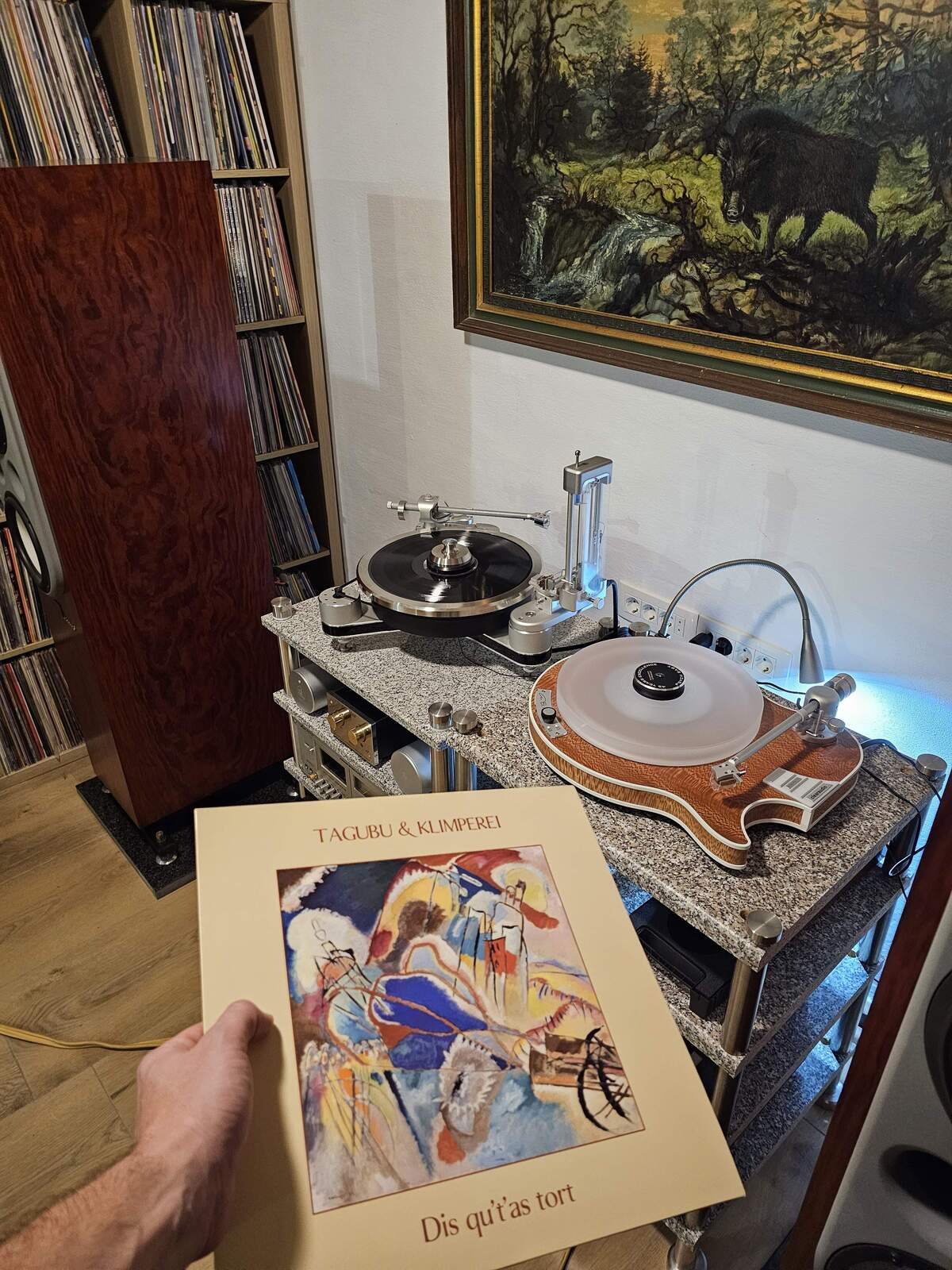
‘Dis qu’t’as tort‘ is a wordless manifesto by Tagubu and Klimperei that weaponizes chaotic instrumentation and biting irony to spit sonic disgust in the face of a world derailing into autocracy.
Klemen Breznikar (It’s a psychedelic baby magazine) January 2026
Henryk Palczewski: ars2.pl 1/01/2026
Denis Tagu‘s interview in French language on Radio Libertaire 6/03/2026
 ADN
ADN