
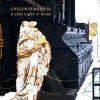
Riccardo Sinigaglia – L’Uccello Del Paradiso
These three previously unreleased tracks reveal the cultural influences surrounding a very young Riccardo Sinigaglia, from the anti-psychiatry movement founded by Ronald David Laing, author of the influential books The Politics of Experience and The Bird of Paradise, to Jung’s theory of archetypes, a subject explored in depth in the writings of Elémire Zolla. The compositional processes of musique concrète are central here, while the extensive use of fragments from other cultures reflects a sensibility refined through Sinigaglia’s travels in Africa and Asia. The blend of aquatic and liquid sounds evokes a shifting state of mind: birdsong, hidden streams, marsh plants, invisible drains, waves of light, and African, Tibetan, and Indonesian echoes. These materials were skillfully collected through various recording methods, including a Teac 3340 four-track recorder and an Akai S612, then assembled on tape with reverbs, equalizers, and the electronic atmospheres shaped through the Revox. Conceived at different times and in different situations, the music is bound together by a shared mood: the waters of Lake Orta as a perennial source of peace and inspiration.
Unter den Artisti del 900 ist Riccardo Sinigaglia der Erste. Wie schon “Works 1976-1981 : Scorrevole“ (AD9 002, 2015) ist auch “L’Uccello Del Paradiso” (1974-84) (AD9 020 / Black Sweat Records, BS105, LP) ein Rückgriff in die frühen Jahre des 1953 in Arona geborenen Elektronikers. Es fanden sich ‘Simbol‘ und ‘Fluttuazioni‘ und mit ‘Laing‘ eine Hommage an Ronald D. Laing (1927-1989), den damals prominenten Begründer der Interpersonalen Phänomenologie, Mitbegründer der antipsychiatrischen Bewegung und Autor von “The Politics of Experience and The Bird of Paradise“. Von den dadurch evozierten Hieronymus Bosch, Gregori Bateson, Sartre und C. G. Jung hinterließen Letzterer und dessen Vermittler Elémire Zollas (durch “Archetypes“) bei Sinigaglia deutliche Spuren. ‘Laing‘ ist durchsetzt mit Zitaten, ‘Simbol‘ nahezu plunderphonisch mit femininem Geflüster, Wellenrauschen, fernöstlichem KlingKlängKlöngKlong und Flötenklang – als Nachhall von Sinigaglias Reisen nach Tibet und Indonesien. Eingebettet in Sound von
Teac 3340 und Akai S612, tapemanipuliert mit Reverbs, Equalizer, Revox. ‘Fluttuazioni‘ verquickt Tamtam mit leichtem Ethno-Touch mit wirbelnder Drum Machine, elektronischer Perkussivität, elektronischem Käuzchen.
Dazu krähen Krähen, und der Ortasee entfaltet in seiner geruhsamen Stille ontologische Sicherheit.
Rigobert Dittmann (Bad Alchemy 135)
 ADN